Wednesday, December 28, 2011

Back in France...

I found this lost post in the draft box. I remember when I took this, it was my first day off and Gabarret was a small town close to the vineyard so I road a bike there early in the morning to get a full day in. I only had one day off a week and it wasn't going to be spent sleeping in.

Sun rising on my way to Gabarret


Wednesday, December 21, 2011

Microalgae and biofuels


Making Biofuel from Microalgae by Philip T. Pienkos, Lieve Laurens and Andy Aden

I was compeled to purchase this recent issue of American Scientist because of the cover article. I am very interested in the possibilities of producing biofuels from the lipids that algae produce because the production of ethanol from corn seems outrageously inefficient and makes little sense as far as renewable fuel sources go. 
The 2005 report "Biomass Feedstock For a Bioenergy and Bioproducts Industry: The Technical Feasibility of a Billion-Ton Annual Supply," or simply the "billion-ton study" that has recently been updated, explains that about 96 billion gallons of bio-based fuels could be harvested from 1.6 billion tons of terrestrial biomass. Unfortunately the current demand is near 200 billion gallons just in the US. And this only being the case if we were to drastically improve the efficiency and ability of obtain maximum theoretical yields for current bio products like switchgrass fermentation, waste from agriculture and forestry, and municipal solid wastes. 
Algae production poses major potential for biofuel production as well as a number of additional byproducts without many of the drawbacks of similar agricultural biofuels. Unlike corn production for ethanol, algae is not a common food source and would not interfere with food production. Many varieties of algae have adapted to almost all aquatic habitats on earth and thus greatly broadens the areas as well as the water types that could be utilized. But as with all new sustainable energy technologies there a number of hurtles that prevent it from even beginning to compete with fossil fuels. 
New and more effective strains of algae must be identified or genetically developed, more effective ways of farming must also be developed, and sustainable use of valuable resources such as water must be kept in mind. In addition, extraction and refining methods need to be improved as well as inventing creative ways of utilizing many of the byproducts. 

Eukaryotic algae possess the highest potential due to their high neutral lipid content, which is important because nearly 100 percent of the triacylglycerols (TAGs) can be converted into fuels. The composition of lipids varies greatly and depends on many factors and a large amount of the lipids are polar and only 30 to 50 percent can be used to produce fuel. "Unlike typical terrestrial oil-producing plants, in which specialized cells yield oils, every algal cell can produce oils." And as with other plant oils, the process of transexterfication allows them to be made into good biodiesel feedstocks. 

***

I feel like this is an amazing idea and there is a lot of room here for improved growing and extraction methods and facilities. Although it is in its infancy, this article shows us that the potential for algae to eventually compete as a biofuel agent is become more and more feasible. Like other renewable energy technologies, algae can be produced here in the US and lessens our current dependency on foreign oil. 
Burning carbon-based fuels will always release excessive CO2 and contribute to global climate change and biodiesel is no substitute. If we are to continue to produce greenhouse gases in the long term we need to develop cleaner and more efficient engines that may work in association with electric. In addition, methods for carbon capture and sequestration should be explored. But with the hopes of reduced dependency on coal with the introduction of renewable energy, algae along with others should put a major damper on what we currently pump into the atmosphere. 

Sunday, December 18, 2011

the replicators


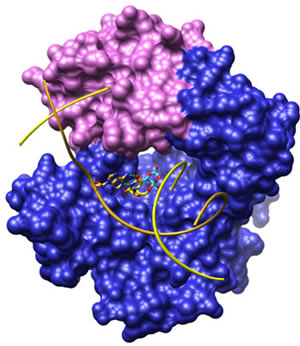
DNA Polymerase

the replicators - The second chapter provides us a look into the beginnings of life on early earth using Darwin's basic theory of natural selection. Dawkins begins by explaining that the term "survival of the fittest" can be see a special case of what he calls "survival of the stable." Everywhere in the universe we find stable configurations of atoms, and on earth we usually give them specific names such as with rocks, ocean waves, and soap bubbles. What we know of early earth is that it was full of many basic elements and molecules that, when placed under certain circumstances, will form new stable forms, even if only for a moment in time, they will be stable nonetheless at that specific point. We have seen in a number of laboratory re-creations of these early earth condition can produce organic molecules such as urea, amino acids (the building-blocks of proteins), and even the basic nucleotides that make up DNA. In our ancient oceans would have become filled with these molecules and over time "at some point a particularly remarkable molecule was formed by accident. We will call it the Replicator." This molecule had the ability of make copies of itself. It may seem extremely unlikely for such an occurrence to happen, but given the span of hundreds of millions of years within this "primeval soup," it becomes increasingly more likely to have happened. And it only needed to happen once. Dawkins explains that it could actually be very possible for a molecule like this two form and gives two possible reasons: One, that explains a molecule's affinity for other similar molecules could build on itself, possibly breaking into smaller pieces of itself and thus leaving numerous copies. The other, that the molecule has an affinity of one particular other kind such that the original now acts as a template.
As with most forms of copying, there will always be a fraction of error involved over time. This error would eventually, over millions of years, make minor improvements that would naturally spread throughout the population and thus we have the basis of evolution. Early earth's oceans would have been covered with a large variety of these replicators, but because there wouldn't be endless availability of the basic building materials, competition would ensue. The favored varieties that would persist might be good at taking up available materials quickly as well as becoming good at defending themselves with protective layers of proteins. Possibly developing early prototypes of the cell.

Friday, December 16, 2011

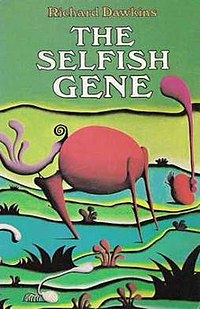
the selfish gene


Being currently unemployed I have decided to begin writing about the books I've been reading lately and anything else I find of interest to write about, though mostly having to do with biology of course...
Today I started "The Selfish Gene" by Richard Dawkins.

Why are people? - We, and all other living organisms on earth are "machines created by our genes." Dawkins gives us the example of a man living in the world of Chicago gangsters and how having an idea of this environment and the fact that this man lived a long prosperous life during these times allows us to make a few assumptions about him. He would clearly be tough, be able to handle guns well, and have strong social ties within the community. This can be seen as analogous to our genes and their long history through an extremely competitive world. Selfishness of a gene would clearly be an important quality to have in order to compete. If this is the case, would a gene show some form of altruism at the individual level in order to achieve it's own selfish goals? "Much as we might wish to believe otherwise, universal love and the welfare of the species as a whole are concepts that simply do not make evolutionary sense." Dawkins makes clear that he will show how individual selfishness and individual altruism are explained by the fundamental law that he calls "gene selfishness." There is a long prevailing theory in biology called "group selection" which explains altruism towards fellow members of the same species would favor the perpetuation of the species. Dawkins then presents us with the "individual selectionist" theory. He explains it as there is almost certainly a minority within groups that will not make the sacrifice for the rest and thus would exploit the altruism of the rest and is more likely to survive, mate, and pass on their genes. Having reproduced for many generations, it would become an indistinguishable between the selfish and altruistic groups.

Saturday, September 17, 2011

Tuesday, July 28, 2009